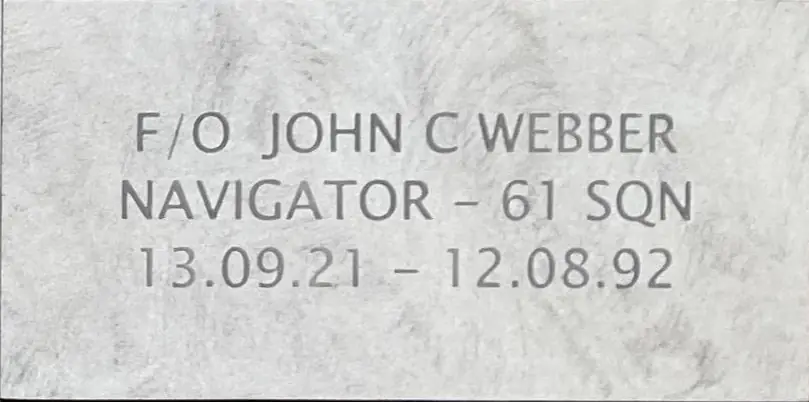
Flying Officer John Charles “Jack” Webber
1921–1992 | No. 61 Squadron, RAF Bomber Command
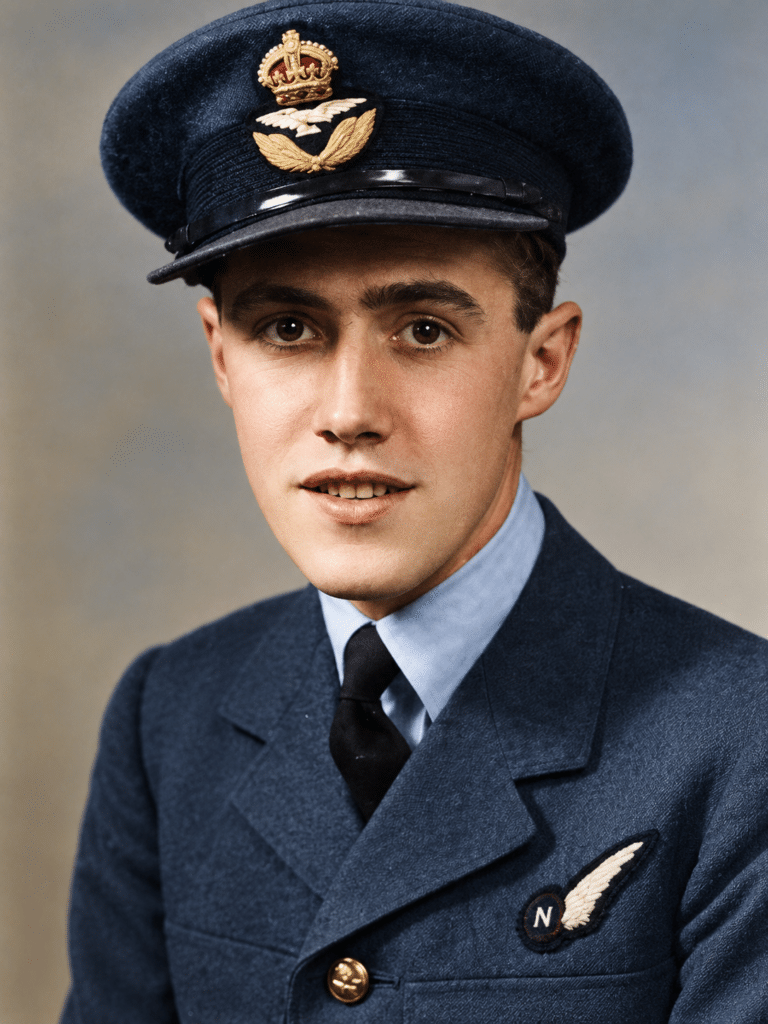
John Charles “Jack” Webber was born in Cardiff on 13th September 1921. Before the war, he attended Cardiff High School and began a career in banking. Like so many young men of his generation, his life and future were transformed by the Second World War.
At nineteen, Jack joined the Royal Air Force Volunteer Reserve on 10th March 1941. Initially selected for pilot training, he travelled to the United States under the RAF’s Arnold Scheme, training in Alabama. He subsequently trained as an air navigator in Canada before returning to Britain. Commissioned as a Pilot Officer, he completed his operational training, and in September 1944 joined No. 61 Squadron at RAF Skellingthorpe in Lincolnshire, flying the Avro Lancaster bomber.
Squadron records show Jack took part in three operations, before setting out on his fourth on the evening of 23rd September 1944. He was the navigator aboard Lancaster LM718, coded QR-K, on a mission to the Dortmund–Ems Canal area in Germany. The aircraft would never return.
Over the occupied Netherlands, LM718 came under attack from a German Messerschmitt night fighter, and was badly damaged. With the aircraft rapidly losing height, Squadron Leader Hugh Horsley ordered the remaining crew to abandon the Lancaster. Jack successfully parachuted to safety before the aircraft crashed near Deurne. Two of the seven crewmen, Twyneham and Jennings, lost their lives. Three others – Horsley, Cawthorne and Hoskisson – evaded capture and reached Allied lines. Jack and fellow airman Wheeler became prisoners of war.
Family recollections tell of Jack briefly finding refuge with a Dutch farming family before being discovered by German forces. Official records establish that he was captured on 24 September 1944. He was eventually imprisoned at Stalag Luft I near Barth, on Germany’s Baltic coast, where Allied airmen endured shortages, uncertainty and separation from home. The camp was liberated in early May 1945, as Soviet forces arrived. Jack had survived the loss of his aircraft and more than seven months of captivity.
Jack remained in the RAF until 1946 before returning to civilian life, where he resumed the banking career that the war had interrupted, eventually becoming a bank manager. He died on 12 August 1992, aged seventy.
Like many Bomber Command veterans, he rarely spoke about his wartime experiences. It was only years after his death in 1992 that our family began researching his remarkable story through RAF records, Dutch historians and surviving crew accounts. One particularly moving discovery was that the people of Deurne had not forgotten LM718. In 1997, a memorial was unveiled near the crash site, honouring the crew and especially the two men who never came home. Jack did not live to see that tribute.
The laying of this stone is dedicated not only to Flying Officer John Charles “Jack” Webber, but also to the courage, sacrifice and resilience of all those who served with RAF Bomber Command. Jack survived the war, captivity and the loss of close friends, yet carried those experiences quietly for the rest of his life. By sharing his story, our family hopes that future generations will remember both the cost of freedom, and the ordinary young men and women who displayed extraordinary courage in its defence.