New exhibition: After Me, The Flood 6th October 2026 – 27th February 2027
After Me, The Flood
After Me, The Flood is a brand new exhibition – one of the IBCC’s most thought‑provoking and historically significant exhibitions to date.
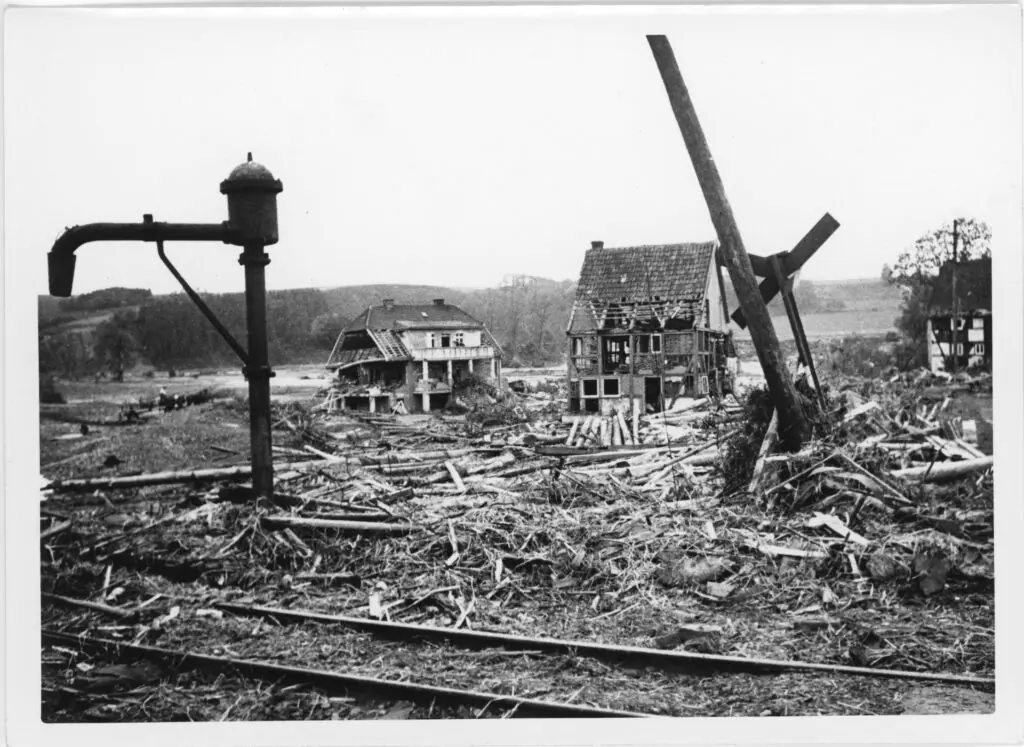
It brings together, for the first time, hundreds of photographs and film recordings captured in the immediate aftermath of the Dambusters raid on the Möhne Dam — and during the extraordinary, harrowing 17‑week reconstruction that followed.
Sourced from town archives, private collections, and local historians across the Möhne region, these images have never before been displayed collectively. Their arrival in Lincoln marks a rare opportunity to witness the human and environmental impact of one of the Second World War’s most iconic operations through the eyes of those who lived it.
We are grateful for the support of a number of institutions and individuals who have made this exhibition possible.
Over the next few months, these pages will be updated to feature stories and themes that will augment the physical exhibition and showcase more images from the collection.
Flight Commander Melvin “Dinghy” Young wrote to a friend in 1939: ‘Since we are to have a war, I am more than ever glad that I am in the air force. It is a happy, healthy life while it lasts, and I have found some old friends and made many new ones…I am not frightened of dying if that is God’s will, and only hope I may die doing my duty as I should’. Dinghy and his crew were killed on their return from the Eder Dam on 17th May 1943
A Story Told Through Unseen Images
The exhibition presents a stark visual record of the devastation caused when the Möhne Dam was breached in May 1943. Photographs taken by Nazi officials, local civilians, and regional archivists reveal flooded landscapes, shattered communities, and the immense scale of destruction downstream.
Alongside these are images documenting the rapid rebuilding of the dam — a reconstruction achieved in just 17 weeks, driven by forced labour under the Nazi regime. These photographs and film reels offer a sobering counterpoint to the celebrated narrative of the Dambusters raid, highlighting the suffering endured by those compelled to restore the structure.
A Rare and Important Collection
What makes After Me, The Flood exceptional is not only the rarity of the material, but the way it brings together perspectives that have long remained fragmented across archives and private holdings. Visitors will encounter a curated visual timeline that deepens understanding of the raid’s consequences and challenges us to consider the broader human story behind wartime operations.
A Space for Reflection
The IBCC remains committed to presenting balanced, evidence‑based history that honours all those affected by conflict. This exhibition continues that mission, offering a powerful space for reflection on the complexities of war, memory, and responsibility.
Book your tickets now
Tickets include After Me, The Flood and the Bomber Command Galleries
And there’s more..
On the exhibition panels you will note there are some morse code messages – for those of you that have not managed to work them out, here are the translations:
GONER –. — -. . .-. This was the code word sent to report that a bouncing bomb had been dropped.
KATASTROPHE -.- .- – .- … – .-. — .–. …. . This was the word used by the Germans to describe the effect of Operation Chastise.
All of the images from the Möhnesee Archive which are used in the exhibition, plus many others, can also be viewed in the IBCC Digital Archive here
The IBCC Digital Archive also contains a number of other items relating to Operation Chastise which you can explore here
A Gunner’s Story
Alfred Lengart was a gunner in the German Army on duty at the Möhne Dam on the night of Operation Chastise. Many years later he was invited to the Yorkshire Air Museum for the opening of the Barnes Wallis Museum. During the opening he delivered a speech of reconciliation.
‘On the moonlight night of the 16th May 1943 I was at my cannon post inside the tower on my left. The bombers were coming straight towards me at zero feet. There seemed to be no space between the bombers and the water. Also I noticed there were two spotlights coming from the bombers onto the water. This I could not understand. The night was so bright I could read my newspaper so why the lights? Then I saw it coming towards the dam. Something that looked like a big ball skipping on the water. It went over the nets, hit the wall and sank. By this time after no notice had been given my heart sank. A few moments later the dam shook. I was badly shaken by this time as I had never seen such daring. Also a rolling mine which seemed to skip over the water with such ease. By this time we were busy returning fire as other Lancasters were coming. The gunfire from the planes coming and going was greater than ours. I could see the roofs being torn away on the towers but this was fifty years ago and is very vague now in my mind. I can recall seeing flashes from the cannon that were hidden on the hills. The sky was lit up with tracer coming and going. Fragments of stone were flying everywhere. Now I wasn’t frightened anymore. Too much was happening. One bomber was hit by cannon fire. We could see he was in trouble and he crashed about twenty or thirty kilometres away. All were killed. The raid was over but we could still hear the drone of the bombers. Then we heard this noise which sounded like a giant tree being split in half. It was the dam as a hundred and sixty million cubic metres of water pressed against the dam. The dam opened and out came the water. Incredible was the sound and spectacular from my position. The valley was soon flooded. We could see that the power station had already gone. Also houses were stripped of rooves and stone and just wooden frames were left. Thousands of people were killed. A hundred and seventeen in my home town of Wickede. But this was war and in my mind no blame could be put on the heads of the pilots or crews as they were only doing what I would have done for my country. But once again this was fifty years ago and I was a young man. So in conclusion all I can say is may our children never have to face each other under circumstances such as those again… [from 08:22] Fifty years ago you succeeded in a military masterpiece that we did not expect to be possible. Unfortunately, a lot of people lost their lives, but it happened during a war which we had started. The fact that today I have seen the possibility to stand in front of you looking into each other’s eyes is for me the most moving experience of my entire life. Therefore, I would like to thank you one more time. May our children never again have to face each other under circumstances as terrible as those we had to suffer from. Again, thank you very much ladies and gentlemen.’
https://ibccdigitalarchive.omeka.net/collections/document/59399
Thanks to our sponsors for this exhibition – Away Resorts-Tattershall Lakes