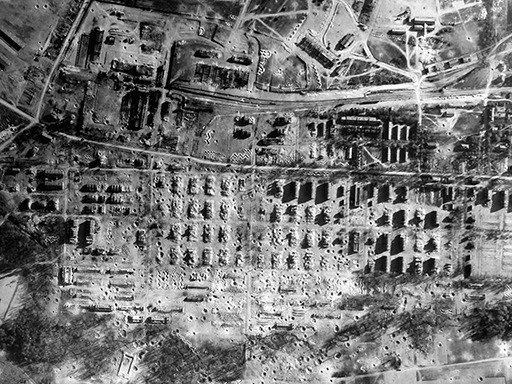
On May 3rd/4th, 1944 – 80 years ago – Bomber Command took part in a daring raid designed to strike a severe blow to the German war machine. The target: Mailly-le-Camp.
Mailly-le-Camp was a German training camp in northeast France that was important for training the elite Panzer divisions. With the approach of D-Day, destroying Mailly-le-Camp would eliminate the threat posed by the Panzer divisions which could have been quickly mobilised to counter the invading Allied forces. It was one of many missions carried out before D-Day to soften up German forces.
346 Avro Lancasters and 16 de Havilland Mosquitoes, from Bomber Command’s 1 and 5 groups, took part in the raid. The plan was that the mosquitoes, led by Wing Commander Leonard Cheshire, would first mark the target by dropping flares while the Lancasters circled 15 miles away at a meeting point.
Once the target was marked, the bombers would be called in to attack the camp. The bombs were to be dropped from an altitude of 6000 to 8000 feet. To minimise civilian casualties in the nearby French village, this was to increase the accuracy of the bombing and reduce scatter.
However, not everything went according to plan.
The Mosquitoes accurately marked the camp on schedule by dropping flares, but the order to begin bombing could not reach the attacking group. The reasons for this included an American jazz broadcast using the same frequency as the RAF that night, some squadrons using Morse code, and others using radio frequency. Plus, some pilots circling at the meeting point were beginning to get nervous and voice their frustrations despite the need for radio silence.
Due to communication problems, the Lancasters continued to circle around the meeting point longer than necessary. By this time, German night fighters from nearby airfields had been alerted to their presence and began attacking. A three-quarter full moon illuminated the bombers, which helped the German fighters intercept them.
42 Lancasters were shot down in just 30 minutes, which amounted to 11% of the total attacking force. 258 airmen lost their lives.
Nevertheless, the remaining Lancasters eventually received the order to attack. They began dropping their payloads on Mailly-le-Camp –1500 tons of explosives.
Due to the high accuracy and intensity of the bombing, the camp was devastated. The destruction included:
- 114 barrack buildings
- 47 transport sheds
- 102 vehicles, including 37 battle tanks
- 218 men were killed, and 156 wounded
Jack Currie, a Bomber Command veteran, wrote in his book about the Mailly-le-Camp raid:
“What has to be remembered about Mailly-le-Camp is that, with all hell bubbling up around them and their fabric of existence hanging by a thread, the great majority of captains and crews gritted their teeth and waited for the order. In that, they won a greater battle than the one they had been briefed for. And when, at last they were allowed to turn their sights toward the target, there were no more malfunctions and no more mistakes. Then, the bomber crews kept faith with their tradition, and with their comrades – with the fifty-five thousand who had died in other battles, and with those who would fly on until the war was won.”
Images courtesy of https://460squadronraaf.com/