Flight Lieutenant Don Charlwood (Royal Australian Air Force) 27 years old in 1942-3 when he served with No 103 Squadron based at RAF Elsham Wolds, Lincs.
In the seven months during the winter of 1942-43 whilst Don’s crew was serving with 103 Squadron, it was the only crew to complete a full operational tour of 30 missions. Of the 20 men from his training course who qualified as navigators with him, only five survived the War.
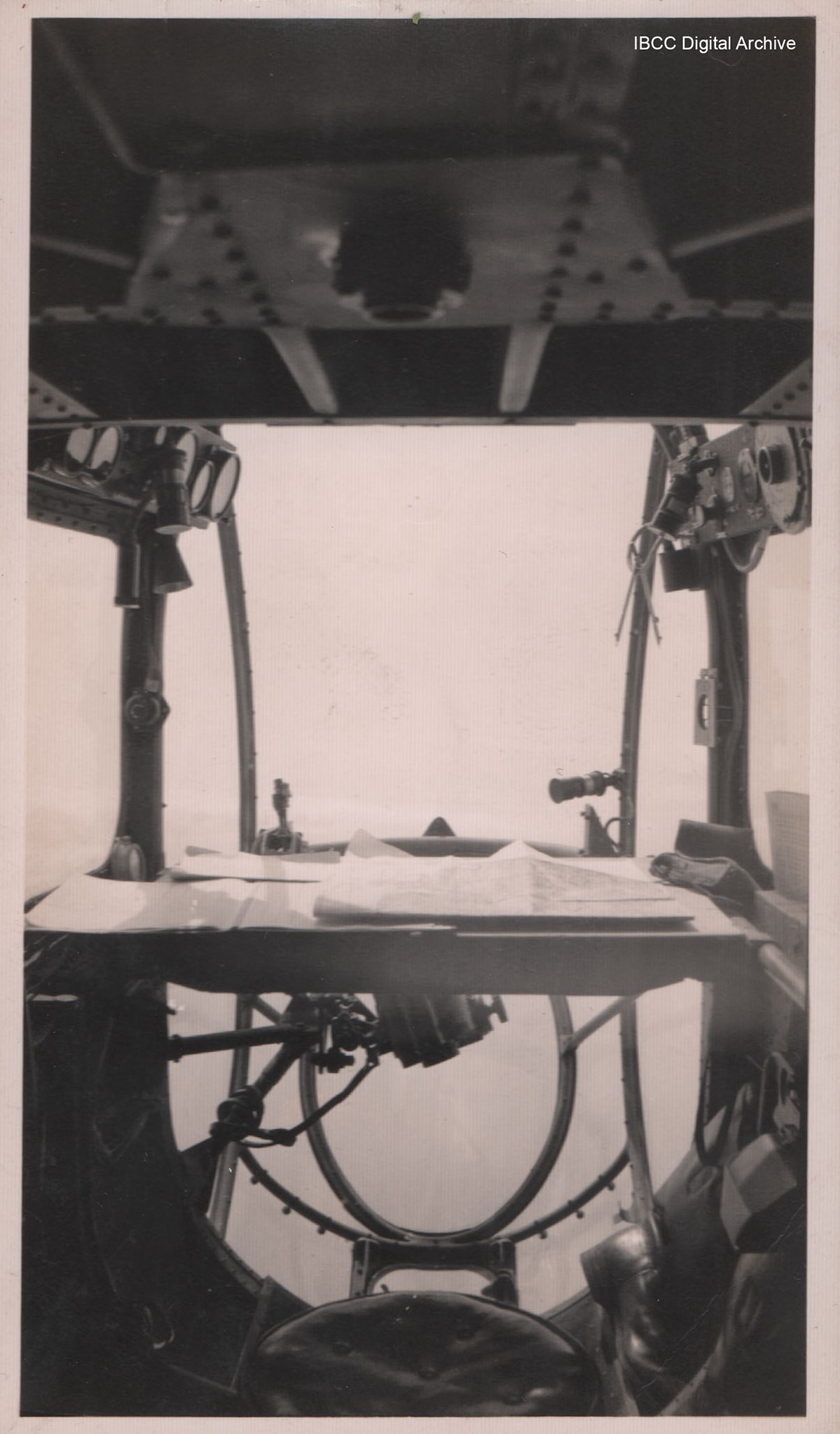
‘We were briefed to bomb Mannheim. We meandered across Europe weaving all the way, found our target and bombed it. On the return journey, about an hour out from the target, an astro fix showed us about 40 miles south of track. I regarded this fix with extreme doubt – astro navigation on operations was a different proposition from during training. Getting another fix was then complicated by the development of high cloud obscuring the stars. Our GEE and our radios were both out of order and, in any event, we were beyond the range of British transmitters. I continued with dead reckoning navigation for almost two hours. For all that time a stronger than forecast wind blew us further south of track. There was still cloud above and below us and no sight of the ground when there was a cry from the rear turret. “Flak, dead astern!” I jumped to my feet. We should by now have crossed the English coast. “Flak coming straight up.” Called the rear gunner. We swung away from it and the pilot called on the intercom, “Navigator, where the hell are we? When we get out of this muck what about a bit of astro?”
I shuffled to the astrodome. The dome was almost over the wireless operator’s head, being shielded from his light by a black curtain. The curtain was tightly drawn, as beneath the light Max, the wireless operator was trying to find the fault with his set.
“I need a star shot”, I said.
“How the hell am I going to work in the dark?” he complained.
“We must have a check”, I replied.
“Do you want this set fixed, or don’t you?” he continued.
“Give me two minutes.”
Growling something, he switched off his lights. I pulled back the curtain and raised my head into the Perspex bubble. I could hear on the intercom, the pilot and the flight engineer discussing how little fuel we had remaining. I am to blame for our predicament, I thought – for throwing away the lives of our crew. I realised that my chief fear of ops had been this fear, the fear of wasting the lives of other men who were relying on me.
Somehow we reached Waddington, our six hours of fuel stretched to seven hours forty-five minutes.’