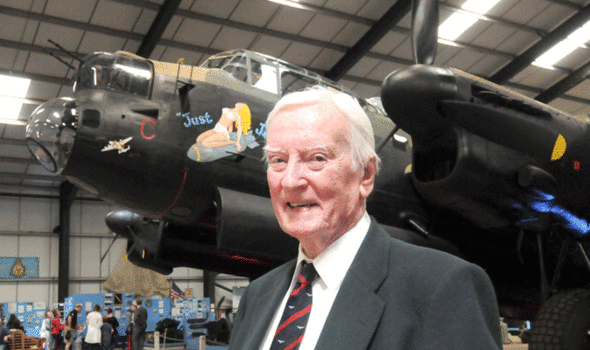
During WW2, very few Bomber pilots flew 60 missions back to back.
One such pilot was Flying Officer Leslie Valentine CdeG. Whose story is quite inspirational.
At the start of the hostilities in 1939, he was called up for military service and joined the Highland Light Infantry as an infantryman. In the ensuing months he was landed in France as a combatant shortly after the Dunkirk Evacuation. His time in France was short lived, and he returned to home shores some 10 weeks later.
A notice was posted on the Battalion notice board asking for volunteers for aircrew, as there was a shortage of pilots and navigators in the RAF.
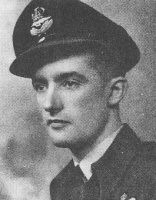 F/O Leslie Valentine CdeG
Valentine, being a mathematician readily volunteered. Only two were accepted, one a 2nd Lieutenant and Pvt Valentine. Unfortunately the 2nd Lieutenant broke his arm and so Valentine went alone through the selection process and was duly installed as a student Pilot in the RAF.
His initial pilot training took place in England, where he was to be introduced to flying in a Tiger Moth. This phase of his training completed, he was shipped off to Canada, to undergo Twin Engine training at Medicine Hat in Alberta, Canada, where he gained his “wings” and the coveted brevet of a fully fledged pilot.
Training completed, the newly qualified bomber pilot was shipped back for active service training to 13 Operational Training Unit in RAF Bicester in Oxfordshire. Training firstly on the Bristol Blenheim, and then over to RAF Finmere 2 miles away to complete operational training on the aircraft that was to be his ‘Partner’ for the next 18 months of conflict. This was the Douglas Boston IIIA, a tricycle under-carriaged light bomber that was both fast and manoeuvrable.
The squadron Valentine was posted to was No.88 Sqn, 2nd Tactical Air Force, Bomber Command. The operations for this squadron were conducted mainly in daylight and in close formation, against targets, where disruption of supply lines was paramount in the halting of enemy reinforcements, road bridges, rail marshalling yards, road transport convoys, submarine pens and V1 rocket launching sites.
Such was the abilities of the Boston that it was the operational choice to undertake the hazardous task of laying smoke over the beaches, to protect the invading UK forces on D Day 6th June 1944.
Entrusted with this, the RAFs most critical role on D-Day, Valentine took his 88 Squadron Boston ‘E-Easy’ down to 50 feet above the D-Day beaches, laying smoke to protect the invasion forces from enemy fire. Above and over his aircraft arched the trajectories of shells from the 14” guns of the capital ships of the Royal Navy 8 miles off shore, and the German 88 heavy guns firing back from just inside enemy lines. Not only was there the chance of being hit by those shells, but, as the UK forces on the ground were unsure who the aircraft flying so low above them were, they also let fly with small arms fire
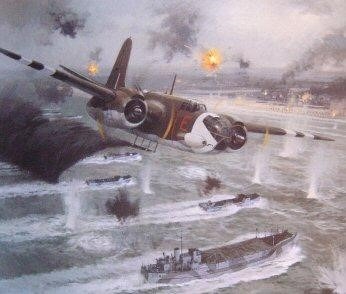 Boston IIIA E-Easy
Two aircraft were lost on this mission, but Valentine returned safely, (if somewhat shaken) to 88 squadron’s base at RAF Hartford Bridge.
Before and after D-Day Valentine flew many sorties against tactical targets by both night and day. He flew two tours back to back, (60 operations in all), in the first tour 36 operations and in the second tour 24 operations with only a 4 week leave between tours. A feat accomplished by only a select few pilots in Bomber Command. He was awarded the Criox de Guerre with Silver Star by the French for his efforts in the battles for their liberation.
In 2013 he was one of the guests of honour at the launch of the International Bomber Command Centre which was held at the Lincolnshire Aviation Heritage Centre, East Kirkby, Lincolnshire.
Unfortunately he passed away in April 2014, at 94 years of age. He had been living in Hethe, Oxfordshire, which is only 4 miles from where he was trained in 1943 at RAF Bicester and RAF Finmere.
Last November, accompanied by his son, he visited the Bomber Command Memorial in London and on his visit was afforded the unique opportunity of being hosted at 10 Downing Street, where Prime Minister David Cameron spent some time with Flying Officer Leslie Valentine and presented him with the WW2 Defence Medal, which he had never received at the time of issue.
His son Sqn Ldr Dudley Valentine has granted permission for Lesley’s log book and personal papers to be included in the International Bomber Command Centre Digital Archive to ensure that his story can help educate people for generations to come.
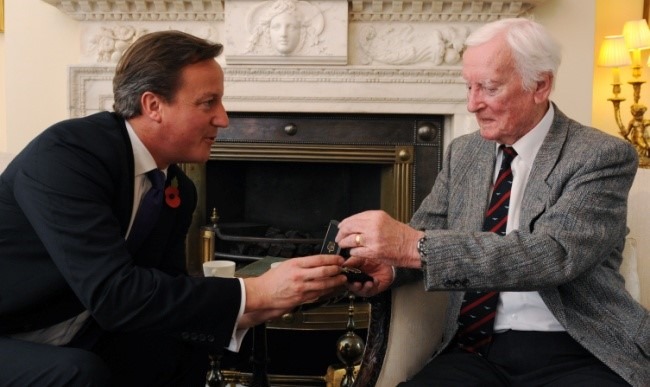
PM David Cameron presents Flying Officer Valentine ensure that his story can help educate people for generations with the WW2 Defence Medal.
There are not many of our WW2 Bomber Command heroes still with us, and at this time, we should set aside a thought in our hearts for those brave aviators who gave their lives for our freedom, and we should give those still with us, our very best regards.