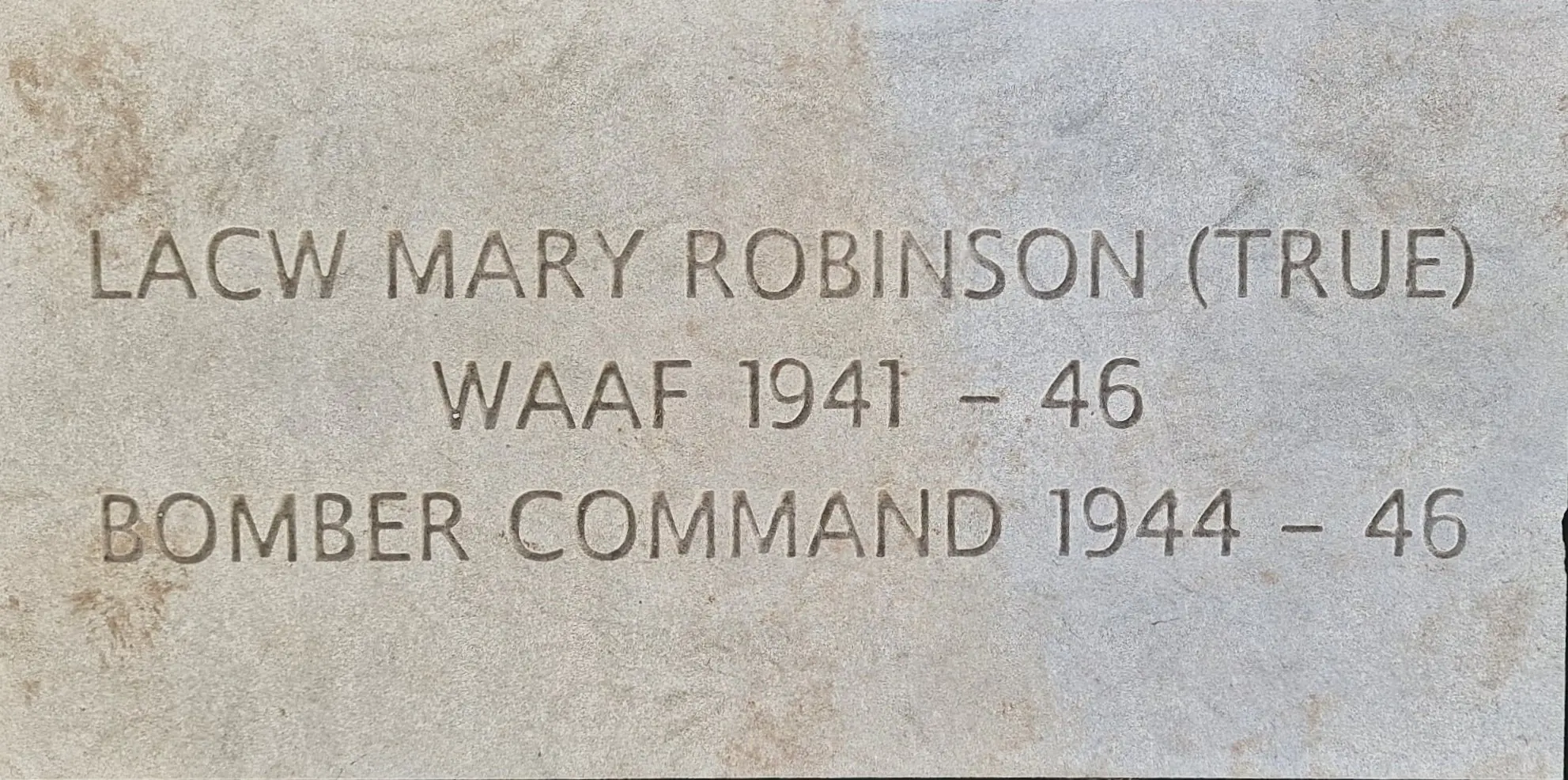
Mary was born in 1920 in Nottingham, the third of four children. Her elder brother Arthur died in a tragic road accident at the age of five, however she was later blessed with Charlie, her younger brother with whom she was very close. As a child she suffered twice from scarlet fever, both times making a full recovery.
After Mundela Road Primary School, Nottingham, she went to Trent Bridge Girls School leaving in 1934 at the age of 14 and joined Wm Hollins (Vyella). It was here that she became a short-hand typist. She was also introduced to general office work. In 1938 she moved to a Bookmaker in Nottingham, where she worked on the Tote system.
As a sports person, Mary especially enjoyed club and County badminton, table tennis and swimming.
With the outbreak of the Second World War in September 1939 the Tote was briefly suspended and Mary’s job ceased.
Her subsequent employment was with the Air Raid Department of Nottinghamshire County Council, mainly manning telephones, continuing until she joined the WAAF in November/December 1941.
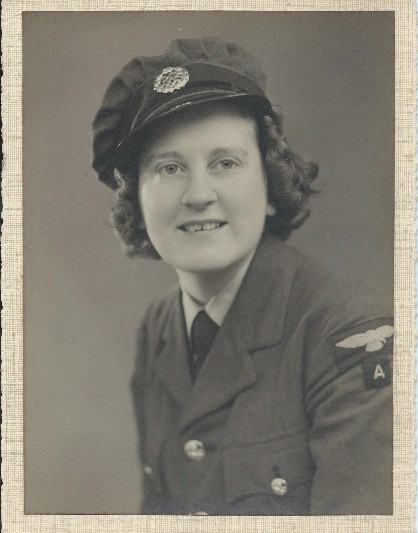
Mary first went to RAF Bridgenorth, which in 1941 was re-named No.1 Women’s Auxiliary Air Force Depot, and specially created for the training of WAAF recruits. This she enjoyed, apart from some very painful injections. Mary made friends easily, and was nicknamed “Robbo”.
After a one-month initial training period, Mary was posted to Bracknell, and seconded to the short-lived RAF Army Co-operation Command, Bracknell, undertaking general clerical and office work.
It was at Bracknell that Mary met her future husband, Corporal Jack True. Mary re-calls: “After being at Bracknell for about a month I met Jack. He challenged me to a game of table tennis. He didn’t know that I was very good at this, having played quite a lot. I beat him to his amazement, then we met up a few times and then started to go out together”. Jack’s recollection was a little different: “I first saw her sitting on a table swinging her legs, laughing and chattering. I thought ‘she looks nice’, so I asked her for a game of table tennis, thinking I could show off a bit. Little did I know she played badminton for Nottingham County, and she was also pretty good at table tennis, in fact she absolutely thrashed me!” Later, Mary’s friends, who all fancied good-looking Jack, asked her why did she play so hard to beat him. She answered, “Well I couldn’t let him win, could I?”
Mary’s next posting was in April 1942 to the newly arrived USAAF, at Wycombe Abbey School, where WAAF personnel (such as those stationed in the message and signal centres) were integrated immediately into the newly formed joint operations. She was one of 26 women, and the posting was for 2 – 3 years maximum, and involved working underground.
By July 1943 US female units were deployed to Wycombe Abbey. Coinciding with an acute shortage of personnel in the RAF, Mary was, thus, posted to RAF Naphill. Here, she worked with one female officer in the office of Commander in Chief of Bomber Command, Air Chief Marshall Sir Arthur Travers (“Bomber”) Harris, preparing reports of the previous nights’ bombing raids. “Bomber” Harris would come into her office every morning and say, “Morning Mary, how are we doing today?” Her work was again underground, typing reports, plotting the bomb drops, and general office work. (We understand that Mary was an extremely fast, accurate and competent typist, with good shorthand skills.)
Mary said of “Bomber” Harris that he was “an extremely nice man, who suffered greatly after the raids, but without his bravery and decisions the War could have gone a lot differently”.
After six months at Naphill, she requested a posting to be nearer Nottingham. Mary continues: “My brother (Charlie – he was a RAF navigator) was missing on a bombing raid over Yugoslavia, and my Mother was quite poorly, and my Father wrote to ask if I could get a posting nearer home. I went to see my Officer, she was very kind, but informed me that I was being put up for promotion to Corporal. I could not accept this promotion as I knew my Mother was suffering from nerves – she never really got over my brother Arthur’s death. So, after a few weeks, I was posted to RAF Syerston, still belonging to Bomber Command.”
RAF Syerston was near Newark, not too far from Nottingham, and was part of No.5 Group RAF (Bomber Command). Mary worked for the Group Commander, which involved accompanying him on his many visits to other local Lincolnshire bases, where she met on a regular basis Guy Gibson (“a bit aloof”) and Leonard Cheshire (“a charming approachable man”).
At RAF Syerston, “I really enjoyed myself here, I came to know another side of the war, having been in Headquarters up until moving here. I met pilots going on to air raids and some never coming back. Life became not so positive as before, and I met some very brave men, who were mostly in their early twenties. I must say that I had quite a hectic time here. We worked hard and enjoyed our time off to the full. My work was mainly in Intelligence. I stayed at Syerston until the war with Germany was over, and was then posted to RAF Kimbolton until my demob in early 1946”.
Footnotes:
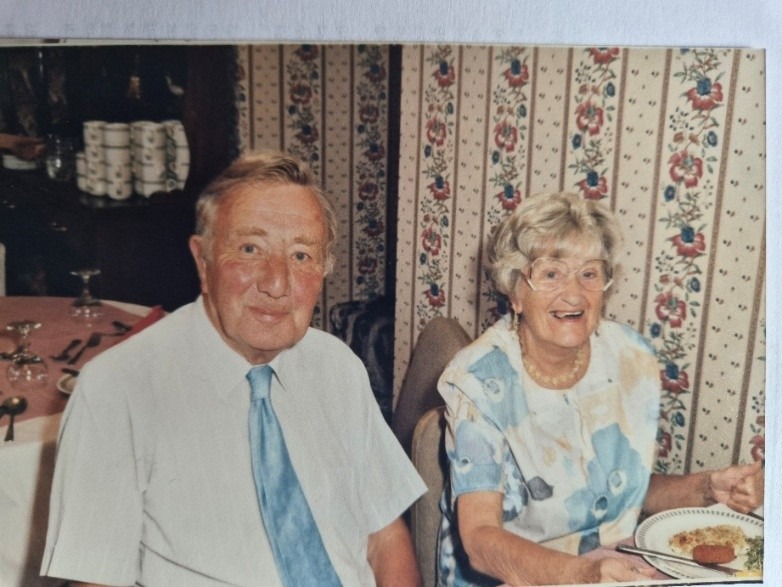
- In 1942 Jack was promoted to Sergeant, and in the November was posted to Iraq from RAF Bracknell for the remainder of the War, returning to the UK in December 1945. Mary and Jack married on March 9th, 1946. They celebrated 56 years of marriage. Jack passed away at the age of 88, and Mary two months short of 93.
- Mary’s daughter (Annie Greatorex) writes: “It may seem odd to us (children and two grandchildren) that Mary said she enjoyed to war, and many times as I was growing up, she would regale me with tales of the fun she had, often with friends with names like ‘Drip’ and ‘Swifty’ (Mary was called Robbo), but she was in her early twenties, living away from home. She was lively, talkative and cheerful. In photos, she always seems to be at the centre of the fun, with a big smile. Had it not been for the war she would have stayed in Nottingham, done a clerical job, married a local lad, life may have been a bit dull. She told me that when Jack returned from the Far East, she couldn’t remember what he looked like – he was like a stranger to her after three years away.”