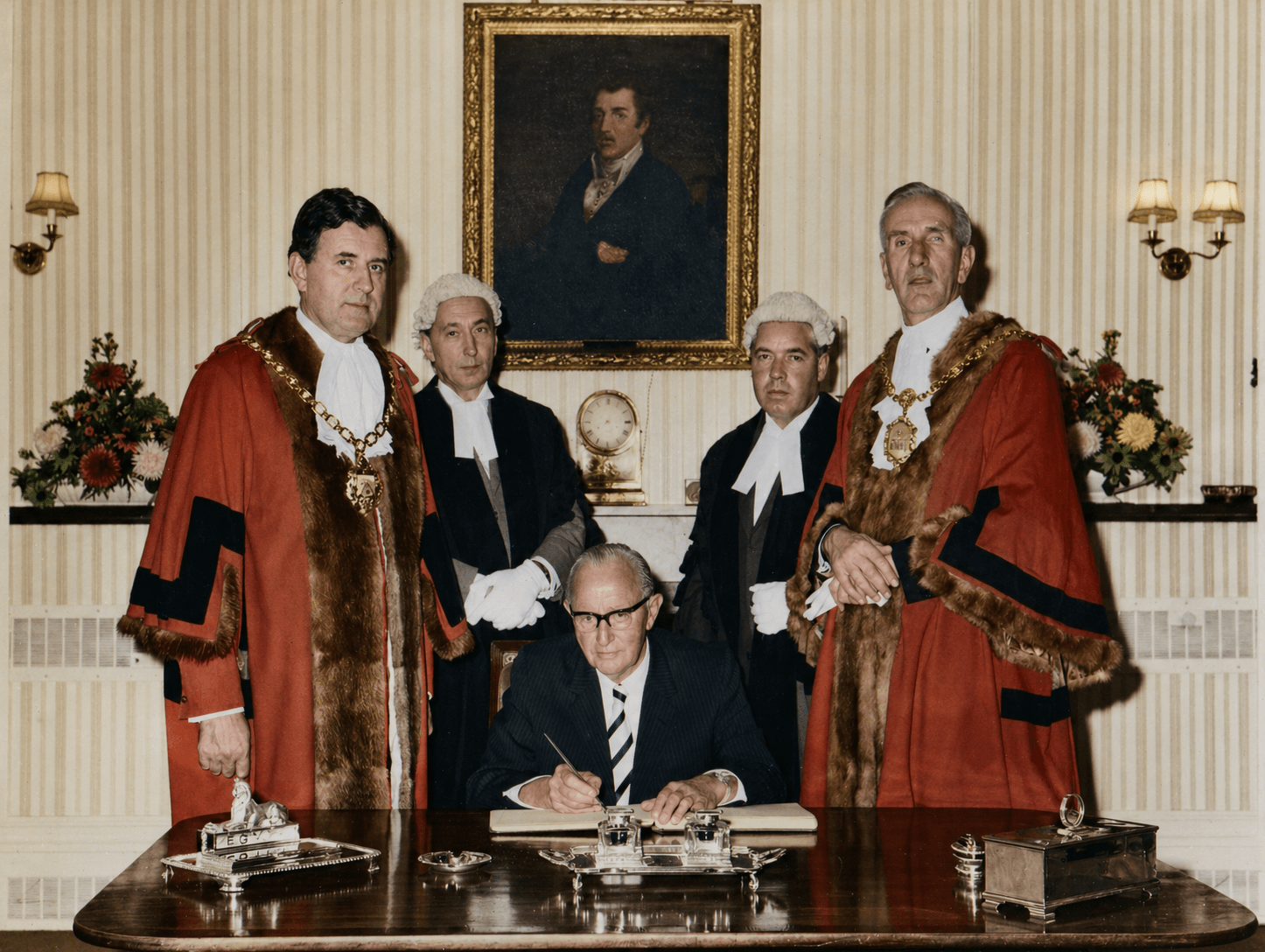
The Significance of Sir George Dowty and His Commemorative Statues
Sir George Herbert Dowty (1901–1975) was born in Pershore, Worcestershire in 1901. He was sent to the Royal Grammar School Worcester after losing his right eye at the age of 12 making a firework.
Sir George left in 1916 to take up a job as an apprentice for Heenan & Froude at a factory in Worcester. Then later moved to Cheltenham to become a draughtsman for the same company. In 1918 Dowty became a draughtsman with the British Aerial Transport Company in London. He then joined the design office of the A. V. Roe & Company at Hamble near Southampton. In 1924 he went to the Gloster Aircraft Company where he worked on undercarriage design.
He stands as one of the most influential British engineers of the twentieth century, bridging the gap between high-performance aviation technology and industrial mining safety. His career, which began with the founding of the Dowty Group, is defined by a unique ability to adapt hydraulic systems from aircraft undercarriages to the harsh, high-pressure environments of deep-level coal mining. The unveiling of statues in his honour including the forthcoming very significant event at the International Bomber Command Centre (IBCC) in Lincoln—serves as a physical testament to his dual legacy: the engineering of critical components for the Avro Lancaster bomber during the Second World War and the invention of the hydraulic roof support, which revolutionised mine safety and saved countless lives.
The significance of the statue to be erected on May 27th at the IBCC lies in the recognition of Sir George’s contribution to the Allied victory in the Second World War. The IBCC is a site dedicated to honouring the men and women of Bomber Command, and Sir George Dowty’s engineering firm was instrumental in supplying the hydraulic undercarriage systems for the Lancaster bomber. Without these reliable, high-performance landing gears, the operational capacity of the RAF’s heavy bomber fleet would have been severely compromised. By his statue being erected at the IBCC, the Sir George Dowty Memorial Committee acknowledges that the “home front” engineers were as vital to the war effort as the aircrews themselves. Furthermore, the statue serves as an educational bridge, highlighting how wartime innovation—specifically the mastery of hydraulic pressure—was successfully transitioned into peacetime industrial applications, such as the Dowty hydraulic prop, which replaced dangerous timber supports in coal mines starting in 1947.
Engineering Legacy and Industrial Impact
Sir George Dowty’s transition from aviation to mining is frequently cited in industrial history as a masterclass in technology transfer. Before the introduction of the Dowty hydraulic prop, coal miners relied on wooden pit props that were prone to sudden failure under the immense pressure of the earth. By applying the same principles used to absorb the shock of a landing aircraft, Dowty created a support system that could be adjusted to changing roof conditions, significantly reducing the frequency of roof collapses. This innovation not only improved the efficiency of coal extraction but also fundamentally altered the safety standards of the mining industry globally. The statues depicting him alongside his iconic aircraft design, serve to remind the public that engineering is a humanitarian endeavour as much as a technical one.
You can find much more information on Sir George here
Headline image: Original photo in the Dowty archive at the Gloucestershire Heritage Hub